Monday, 10 March 2014

SankaranKutty

First in the classic malayalam movie inspired typography series, this rendition explores various facets of Malayalam as a language and its quirkiness.
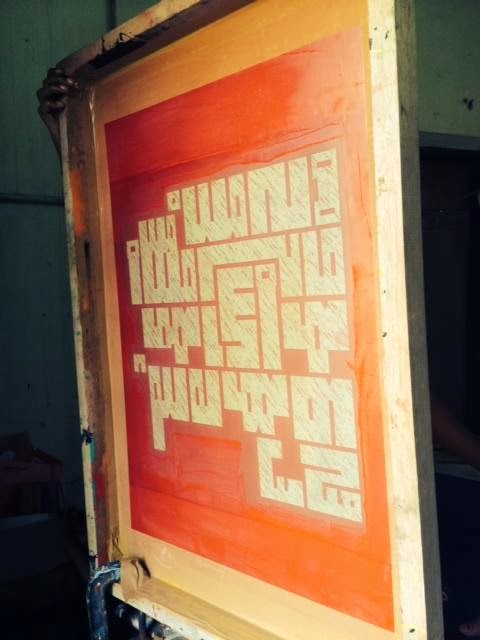
the negative (silk screen)
 Ee Sankarankuttiku penu venam, is literally translated as: this Sankarankutty wants a girl. It is also a very common phenomenon in Kerala (and India) that parents are really worried if their son or daughter will settled down! So here's a tongue-in-cheek wearable placard that's perfect for the boys.
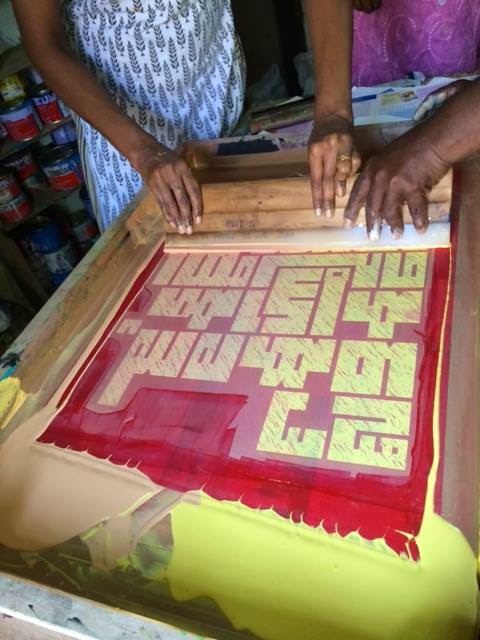
the process of screen printing takes two sets of hands for large sizes
Now this may stand true for any guy living anywhere is the world, what identifies our guy as a mallu, is his name Sankaran!. Derived from mythological name Shankar, a fairly common name on this subcontinent, the added Sankar..an stamps it typical Kerala.
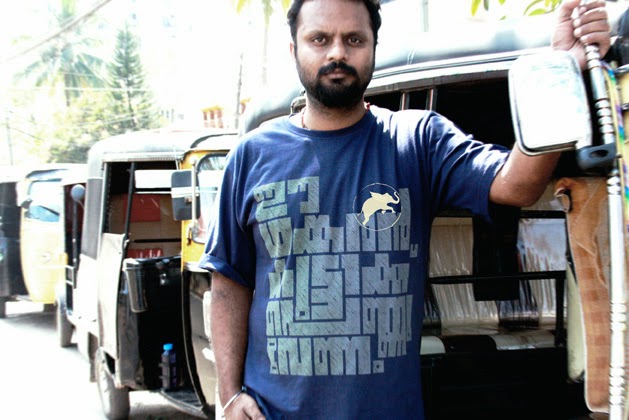
the brave mallu man!
And then there is kutty.. it is a common suffix, used mostly as a term of endearment (a child is called kutty) but it often ends up becoming a term in one's official name; be it male, female, Hindu/Christian/Muslim.... someone with kutty as part of their name is definitely from Kerala! We even have persons called Babykutty - which translates baby baby!

Silk screen printed on 100% cotton t-shirts, they are meant for.. well, everybody!
Limited edition. Available in stores now.

Wednesday, 12 February 2014

earth&fire made magnets


Up-cycling the handmade produce from Kerala, we initiated terra-cotta works as Kaithozhil*, hand sculpted & fired earth magnets. 
Following the same thread of idea we are introducing, hand sculpted ceramic magnets. Celebrating the idea of travel and freedom, be it on foot, ubiquitous rickshaws or soaring high in sky, with these little mementos.

Both terra-cotta and ceramic magnets are crafted in similar fashion, made of fired earth even the process almost remains the same. Its the minor changes in temperature, water content, curing etc that brings out such dramatic differences in both these products. And because of certain qualities of ceramic it makes them suitable for glazing. Glaze is a coating fused to a ceramic object to make it non-porous, though it also finds its uses in many other decorative ways. 

 They are available in 3 lively hues. You can pick them up from our Cochin and Thekkady stores.

*hand crafted

Monday, 3 February 2014

Silk-Screen Printing

Screen printing has been around for quite a few centuries and even to this day is a widely used practice. Almost anything that can be flattened, can be screen printed. Be it paper, cloth, canvas, wood, metal....

This process is more or less on the lines of developing photographs from a negative. The film is transferred on to a silk cloth, and this cloth becomes the screen (negative) over which colors are spread and printed on to the chosen material.
Hence the term, Silk Screened!

Simple enough, yes!?

Well, it definitely sounds so, BUT imagine when there are multiple prints, here
-every sheet of paper/t-shirts needs to be cut or folded to the same size
-placed correctly under the screen
-every batch of the color mixed (there is ink, solvent) and tested to achieve if not exactly the same, but closest to the desired color.
-the pressure with which the color is spread should be consistent or else color density on the print wouldn't remain the same. If its a big print, like in case of our t-shirts, more than one set of hands maybe required.

All these for a single screen, which prints one color at a time. And now repeat all the above for the second color given to the artwork, and so on.. And with each added screen, alignment or 'registration' as its called in print terminology, gets trickier.

The beauty of this whole process lies in its simplicity. It is easy enough to be set-up within a small space and yet is labour intensive, maybe that's why screen printing makes for a perfect small scale industry. Photos are taken in Johnson's living room at home which doubles up as a silk screen room.